


Our services
Let us support you with our expert solutions
Safety Data Sheet (SDS) creation in accordance with REACH and CLP. We provide translations into all European languages
Poison Centre Notification in accordance with Annex VIII to CLP

Classification and Labelling Inventory (C&L Inventory) Notification
Safety Data Sheet (SDS)
What is a Safety Data Sheet (SDS)?
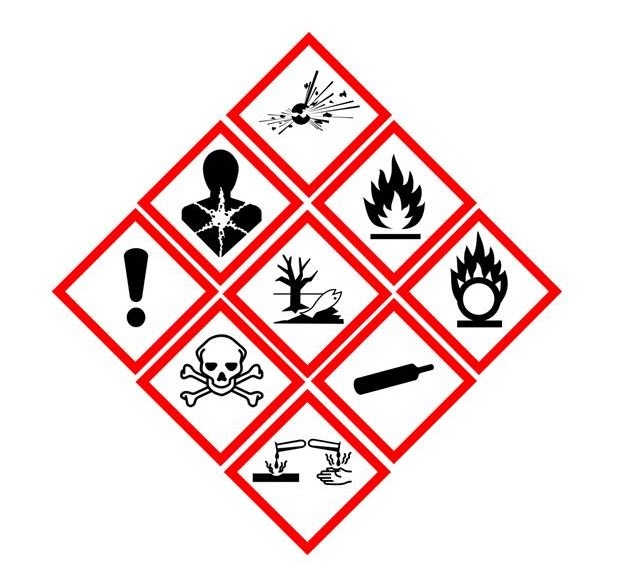
Safety Data Sheet (SDS) is a mandatory document in the trade of chemicals within the European Union and serves as a fundamental tool for hazard communication for professional users. Hazard information in the Safety Data Sheet is provided using the GHS system, the provisions of which are implemented through Regulation (EC) No 1272/2008 (CLP). The Safety Data Sheet also contains information on the physicochemical properties of a substance or mixture, as well as the conditions for its safe use.
Role of the Safety Data Sheet (SDS):
• Enables the application of health and safety protection measures in the workplace
• Supports environmental protection
• Provides information on hazards posed by a substance or mixture
• Contains guidelines for safe handling, storage and disposal of a substance or mixture
Who can create safety data sheets?
The Safety Data Sheet should be prepared by a so-called "competent person."
The ECHA guidance explains this term as follows:
"a person (or combination of persons) – or a coordinator of a group of people - who has or have, as a result of their training, experience and continued education, sufficient knowledge for the compilation of the respective sections of the SDS or of the entire SDS''.
Language
Safety Data Sheet should be provided in the official language of the country in which the substance or mixture is placed on the market.
Safety Data Sheet in EU
Each manufacturer, importer, downstream user and distributor must collect and keep all required information (including that provided in the safety data sheet) relating to REACH Regulation for at least 10 years after the last date of manufacture, import, supply or use of the substance or mixture.
As of January 1, 2023, the format of Safety Data Sheet according to Commission Regulation (EU) 2020/878 (update of Annex II to REACH Regulation) applies in EU countries.
Labelling and packaging
General principles
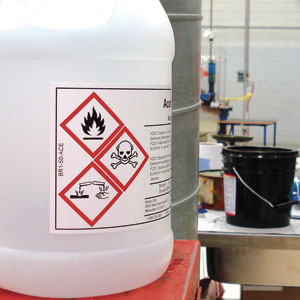
According to the CLP Regulation, labels must be firmly affixed to the container and readable when the product is typically positioned. Label elements such as hazard pictograms must be clearly visible. All information on the label must be legible and durable. If the information is already clearly displayed on the packaging, a separate label is not required.
Label for a mixture classified as hazardous
Label must include supplier data, nominal quantity of substance or mixture, product identifiers, hazard pictograms, signal word, hazard statements, precautionary statements, and other supplementary information if applicable. Additionally, a Unique Formula Identifier (UFI) may also be included (if applicable) according to Annex VIII of the CLP Regulation.
Language
Label must be created in the official language or languages of the country where the substance or mixture is placed on the market. The supplier may prepare a multilingual label or separate labels for each country.
Packaging for mixtures classified as hazardous
According to the CLP Regulation, packaging must be solidly constructed and sealed in such a way as to prevent the escape of substances. The materials used for packaging must be resistant to the contents and must not react with the substances inside. The packaging must be solid and leak-proof, and their closures should be designed to be opened and closed repeatedly without the risk of substances escaping. Additionally, these packages must not attract children's attention, must not be confused with packaging for food products, animal feeds, or medicinal or cosmetic products, and must not mislead consumers.
Mixtures supplied to the general public
For substances and mixtures available to the general public, CLP regulations require the use of special precautions, such as child-resistant fastening (child-resistant closure), tactile warning of danger, and specially designed packaging for liquid laundry detergents in single-use soluble packaging.
Poison Centre Notifications
Regulation 2017/542 (Annex VIII to CLP) regulates the rules for reporting mixtures to poison centers.
Importers and downstream users introducing new mixtures to the market must comply with Annex VIII to the CLP Regulation from the following dates:
- Mixtures for consumer and professional use - from January 1, 2021
- Mixtures for industrial use (new mixtures and existing ones when the transitional period is not applicable) - from January 1, 2024
- By January 1, 2025, responsible parties must submit notifications in accordance with the requirements of Annex VIII for all mixtures (existing and new) introduced to the market.
Mixtures classified as hazardous based on their physical effects or effects on health must be reported before being placed on the market in member states, in accordance with the requirements of Annex VIII to CLP. Information must be provided in the language(s) of the country where the mixture is placed on the market.
Each notification requires the creation of a special alphanumeric code called a Unique Formula Identifier (UFI). The UFI must be placed on the label of mixtures classified as hazardous based on their physical effects or effects on health. For mixtures that are not packaged or for industrial use, the UFI may alternatively be placed in Section 1 of the Safety Data Sheet.
Annex VIII allows for group submission of information if mixtures have similar compositions (excluding some fragrance substances) and if they have the same classification for health and/or physical hazards.
According to Annex VIII to CLP, for industrial mixtures, a limited submission is permitted, requiring the provision of a telephone number and email address available 24 hours a day, 7 days a week for quick access to additional information about the mixture.
C&L Notifications
In the case of production or import of a substance classified as hazardous, regardless of the quantity, such substance must be reported to the Classification and Labelling Inventory (C&L inventory) within one month from placing the substance on the market.
In the case of importing a mixture containing a substance classified as hazardous in a quantity exceeding the relevant concentration limits, resulting in the classification of the entire mixture as hazardous according to the CLP Regulation, this substance must also be reported to the Classification and Labelling Inventory (C&L inventory) within one month from placing the mixture on the market.
It is not necessary to separately report to the C&L inventory substances that have already been registered under REACH, provided that the required information for reporting has already been provided as part of the REACH registration documentation.
© 2025 LibCSM. All Rights Reserved.